
This item cannot be returned.
Arturia ARP 2600 V3 License (Download)
ID: 6934
• MPN: 210504_Down
• SKU: 1090-31

Authorized Dealer


In Stock


$149.00
100 in stock
Key Features
- • Recreation of ARP 2600 Synthesizer
- • Oscillators
- • ARP2500 Multimode 12dB/Octave Filter
- • Extensive Modulation Routing
On Sale




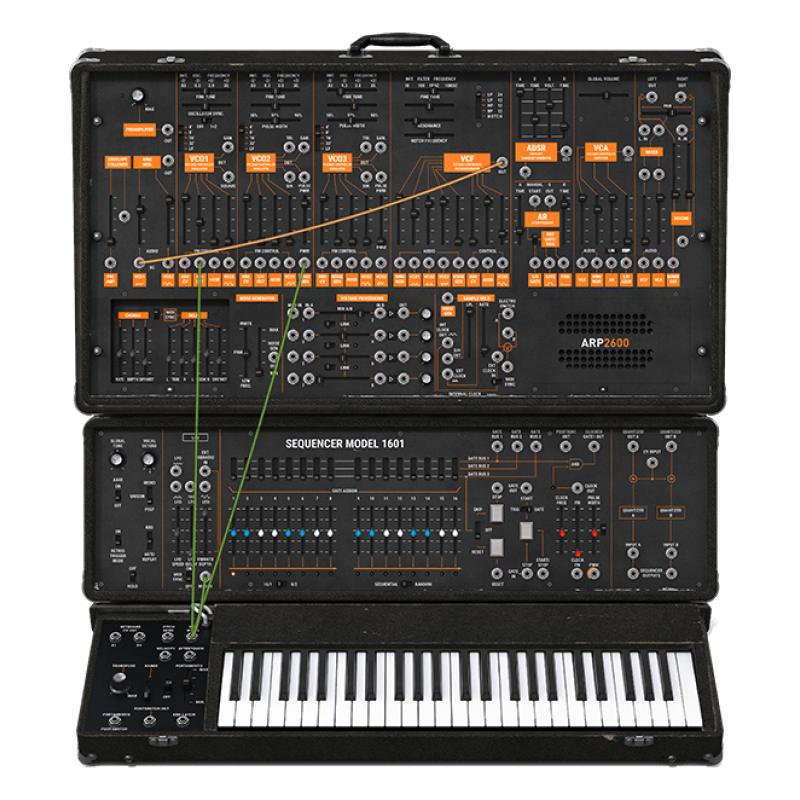
Arturia ARP 2600 V3 License Overview
Coveted semi-modular classic.
ARP 2600 V reproduces one of the most desired synthesizers ever created, responsible for sounds ranging from ’70s funk textures to unmistakable special FX. Experience it in perfect plugin detail, with enhancements overflowing with creative ideas for any genre.
The ARP 2600 went from educational concept to rock 'n' roll icon, and was the sound of both R2-D2 and Edgar Winter's "Frankenstein."
A modular synth in a suitcase, the 2600 immediately appealed to musicians. You could patch it like crazy, but didn't need to. Its versatile sound became a favorite of Stevie Wonder, Josef Zawinul, Tony Banks of Genesis, Martin Gore of Depeche Mode, and many more. Combining True Analog Emulation® signature authenticity with vastly expanded features, ARP 2600 V is designed to become one of your favorites too.
To Patch or Not To Patch
Like the original, ARP 2600 V has a normalled signal path. Get great sounds right away or experiment with patch cables – it's up to you!
Essential Ingredient
Whatever your musical style, something you do will call for the inimitable sound of the 2600. You may as well have the best software emulation there is.
Modular Mentor
With a left-to-right layout that follows signal flow, there's no better way to learn the fundamentals of synthesis than with ARP 2600 V.
All Bases Covered
Combining modular freedom, easy sequencing, and real-time keyboard performance controls, ARP 2600 V is an instant gratification machine – you'll lose yourself in no time.
Alan R. Pearlman designed electronics for NASA. His passion for music soon sent a new kind of synthesizer into orbit.
It was this passion, combined with his engineering expertise, that led him to found ARP Instruments. ARP not only built some of the most complex and coveted synths of their time; the name left a lasting impact on the world of synthesis, contemporary music, and even cinema.
By 1968 Pearlman had already helmed and sold a successful company that made operational amps based on his aerospace work, but became interested in building electronic instruments after hearing that a certain famous synth brand had issues with temperature and tuning. His own early designs proved more stable, inspiring him to press forward.
In 1969 Pearlman and David Friend formed Tonus, later rebranded as ARP after Pearlman's initials. Their first product was the 2500, a large modular system that used a matrix of sliders instead of patch cables.
"Close Encounters of the Third Kind" made the 2500 a cultural icon as the synth used to communicate with space aliens. ARP's Phil Dodds even appeared in the scene, playing the iconic five-note motif. Pearlman soon saw the larger potential of a portable and relatively affordable synth for working musicians and educators, leading to the 2600, first released in 1972.
Friend and Roger Powell (keyboardist of Todd Rundgren's Utopia) hit the road to convince retailers to stock the 2600, and initial responses were mixed. The 2600 got a big boost when Edgar Winter slung it keytar-style on the rock jam "Frankenstein." Pete Townshend played the stereo wah riffs of "Who Are You" by processing his guitar through a 2600, and sound designer Ben Burtt used one to create the vocabulary of R2-D2.
What set the 2600 apart was, first, it was semi-modular: Pre-wired connections meant that beginners could play notes without touching a single patch cable. Second, its visual layout corresponded to the signal path. Both benefits appealed to teachers.
Further ARP hits included the Odyssey, Axxe, and Omni. By the mid-'70s ARP commanded a 40% share of the synth market. To this day, the 2600 remains their marquee instrument, and ARP 2600 V puts all its power and more in your hands.
It may look complex, but everything about the 2600 was intended to teach synthesis concepts and get you creating sounds in record time.
ARP 2600 V builds on this tradition first by duplicating the semi-modular flow of the original – patch cables optional. But click any patch point and all eligible points for the other end of the cable light up. That's just the beginning.
System Requirements
Mac
• Mac OS 11+
• 4 GB RAM
• 4 cores CPU, 3.4 GHz (4.0 GHz Turbo-boost) or M1 CPU
• 3GB free hard disk space
• OpenGL 2.0 compatible GPU
Windows
• Win 10+ (64bit)
• 4 GB RAM
• 4 cores CPU, 3.4 GHz (4.0 GHz Turbo-boost)
• 3GB free hard disk space
• OpenGL 2.0 compatible GPU
• ARM processors not supported on Windows