
Rob Papen

52 items
Price
Categories
Manufacturer
Operating System

Key Features
- • 16voice virtual analog synthesizer
- • Over 1600 top-quality presets
- • 2 Oscillators with a dedicated advance panel offering an LFO and Envelope for modulating different parts of the Oscillator X
- • Classic waveforms in each oscillator included 'Tuned Noise'


Key Features
- • 11 Legacy Plugins
- • 18 Instrument Plugins
- • 15 FX Plugins

Key Features
- • 16-voice virtual synthesizer designed for various new types of synthesizer plucked sounds and more.
- • WirePluck's base is up to 3 Layers, with 4 source types
- • Source layer can be 'Wire', 'String', 'FM', or 'Wave' type
- • WirePluck has 2 LFOs that generate modulation signals

Key Features
- • The Vocoder mode. This is the classic Vocoder mode. RoCoder in its Vocoder mode can use up to 32 bands with a built-in carrier synthesizer.
- • The Additive mode. Instead of Vocoding, the engine generates 32 bands of harmonics using sine waveforms. The additive mode works in a similar way to the Vocoder as previously explained, however instead of a carrier signal, 32 sine waveforms are generated, their volume being that of the corresponding modulator band, so as to generate an atonal sound FX. There is still the option for keyboard control and even polyphonic notes are possible, although due to the atonal sound, it very often sounds far
- • The Combined Additive and Vocoder mode. This feature of RoCoder offers the ability to combine two modes! Keep in mind that this mode is more CPU intensive, and the atonal FX of the Additive means that ‘tuned’ usage is more difficult. Still, an interesting mode to create new unheard sounds!
- • The Noise mode. In this mode, the MIDI keyboard notes are used for creating the bands. If you only play one note, let’s say A4 then only one band at a frequency of 440Hz (A4) is used. So the number of bands used depends on the number of notes you play. In this mode, the MIDI keyboard notes are used for creating the bands. If you only play one note, let’s say A4 then only one band at a frequency of 440Hz (A4) is used. So the number of bands used depends on the number of notes you play.

Key Features
- • Air: Air works as a booster of very high frequencies with a wide bandwidth using a top-notch algorithm. Its effect is perceived as giving the audio a more breathing space or ‘Air’.
- • Mono / Stereo Split Filter is able to divide the audio signal into a mono and stereo part based on a frequency.
- • The Solo switch, when engaged, only lets the transformed mono signal pass.This feature is handy to seek out the correct range.
- • The Mode setting determines how the stereo audio signal is turned into a mono signal. The options here are: Left Channel, Right Channel, the sum of the Left and Right Channels averaged (L+R), and the signal difference between the two channels (L-R).
Key Features
- • 18 Instrument Plugins
- • 15 FX Plugins
- • 11 Legacy Plugins

Key Features
- • Current Presets A /B: A Preset in RP-EQ has two slots, A and B, to store two variations of the Preset. The A and B variations are useful to compare different versions while you are editing. The current, live, settings can be recalled at any time via the Current button
- • Volume control with in the uppers section the 'on/off' option for 'volume correction' if volume goes over 0dB. Bypass button to hear the difference between the 'original' signal and 'RP-EQ' signal.
- • Spectogram: The spectrogram displays the input and output signal as an FFT Spectrogram, a 30 band (1/3 octave) Bar Spectrogram or a 30 band (1/3 octave) Single line Spectrogram. The icons on the left hand side of the Spectrogram display switch the display mode between FFT Spectrogram, Bar Spectrogram and the Single Line Spectrogram. Controls for 'Hold' and 'Release' of the peak lines in Bar mode. Control of 'Release' in the Single Line mode. Display mode of: Left, Right, Stereo or Mid/Side Addit
- • 8 band EQ which can work in normal mode or Mid/Side mode. In Mid/Side mode, the Bands 1-4 are for the 'Mid' signal and Bands 5-8 for the 'Side' signal. Graphic control panel and lower control panel with additional setting options for view , solo or lock a single band.
Key Features
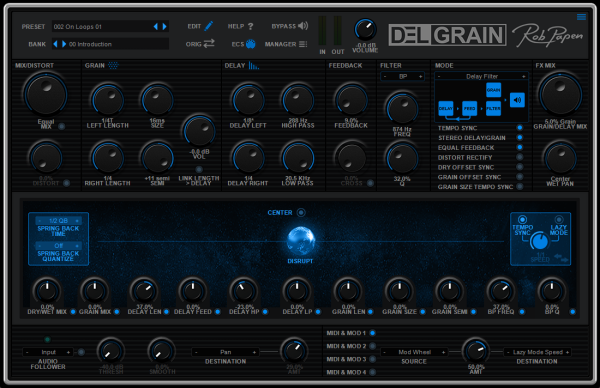
- • DelGrain combines Granular Delay with Tape Delay, a distortion module, an analog-modeled Filter section, and various routing modes, all controllable by the creative Disrupt Sphere
- • Dry/Wet and FX Mix controls
- • Distortion parameter with Rectify mode option.
- • 5 Different Routing options for Grain Delay, Delay, and Filter

Key Features
- • The concept of DelSane is two-sided. The first (sane) side is a smooth-sounding Tape Delay which can be easily used as a Stereo or Mono Delay in your music production or as (insane) a creative, think out of the box Delay FX device.
- • The delay goes from 1.0ms up to 4093.ms and in tempo-sync mode from 1/32 Tripple note up to 1bar.
- • The layout is easy to understand and this DelSane can be your basic go-to Delay plug-in for many future music productions.
- • The cool ‘Equal Feedback’ feature gives the Stereo Delay a smooth equal Left and Right tail Feedback.

Key Features
- • 16voice virtual analog synthesizer
- • Over 1600 top-quality presets
- • 2 Oscillators with a dedicated advance panel offering an LFO and Envelope for modulating different parts of the Oscillator
- • Classic waveforms in each oscillator included 'Tuned Noise'

Key Features
- • Main features Hybrid Synthesizer with Analog Style Sounds as well as Hybride Wavetable Sounds. Over 6100 Presets in various music styles. Bank Folders that start with 0 in their name are Predator-2, and Predator-3 Presets. Bank Folders that start with 1 in their name are Predator-1 Presets. GUI is available in 4 sizes being 100%, 120%, 133%, and 200%. Animated dials are available.
- • Oscillators 3 Oscillators with Sub-Oscillators. Subtractive analog-modeled waveforms. Additive spectrum waveforms. 8 User spectrum waveforms are available in each Preset. Different dynamic waveforms Morphing inside each Oscillator. Spread feature, creating a 3 Oscillator detuning within each Oscillator. Various audio modulation in Oscillators 2 and 3. Diverse routing options into the Filters.
- • Filters Two analog-modeled Filters with various routing options 38 Filter types Pre-Filter distortion Filter-1 Filter Envelope with Attack, Decay, Sustain, Sustain-Fade, and Release. Additional High Pass Filter with Resonance (Q)
- • AMP Volume and Velocity control. Pan control. EQ mixing preset menu. 11 Distortion modes.

Key Features
- • 16 Voice virtual synthesizer
- • GUI size 100%, 125%, 150%, and 200%
- • Different tunings possible using .tun files
- • Responds to MIDI Program change and MIDI Bank Select
Key Features
- • 18 Instrument Plugins
- • 15 FX Plugins
- • 11 Legacy Plugins

Key Features
- • Sound Presets consist of 4 separate Layers for rich, complex sound synthesis.
- • Unlimited sound programs, Sound Browser
- • +2100 presets by Rob Papen and various artist
- • 4 oscillators per Layer, 4 types. Oscillator modules include Analog-type, Digital-type, Noise-type and Audio Input-type. FM modulation and AM modulation. Oscillator Sync in Analog Oscillator 2 and 4

Key Features
- • Dry / Wet control
- • Wet only button
- • FX bypass button
- • ECS (external MIDI controller setup)